
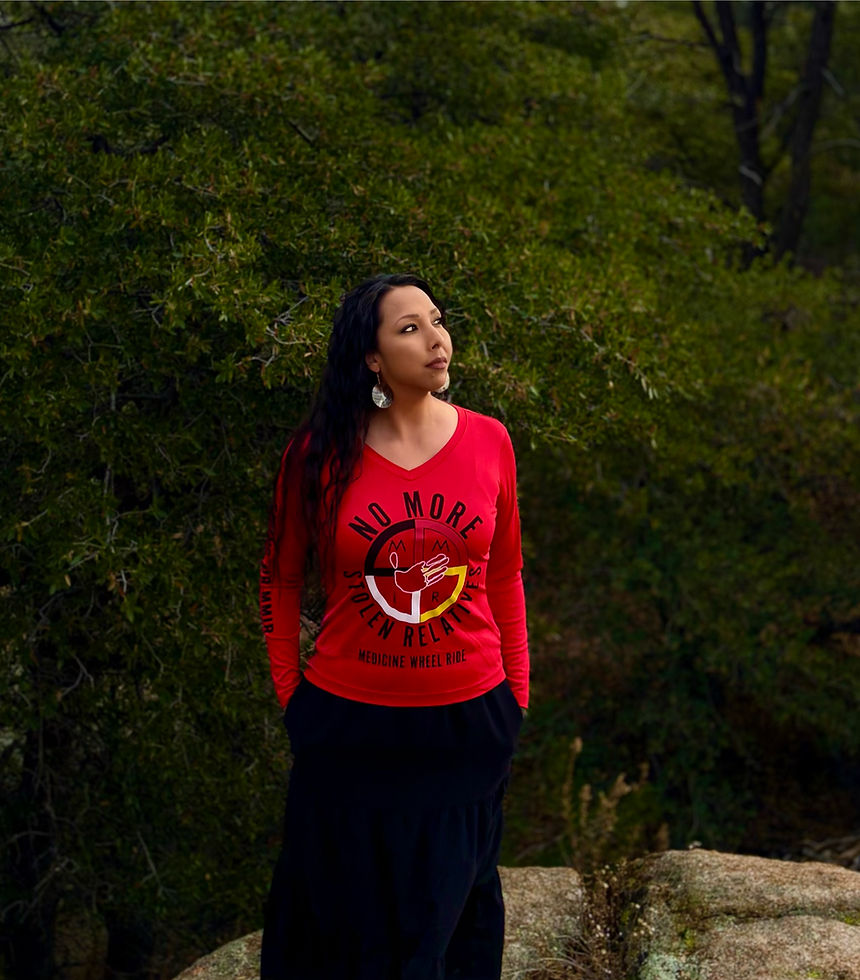
- Casandra Stouder
- 7 days ago
- 4 min read

Most people have heard the words "Missing and Murdered Indigenous Peoples." Almost nobody knows how the machinery actually works. Let's go there.
Start with two numbers: 5,712 and 116
In 2016, the National Crime Information Center received 5,712 reports of missing American Indian and Alaska Native women and girls. That same year, the Department of Justice's public missing persons database — NamUs, the one families, researchers, and the media actually search — logged 116 of them.
Not 116 fewer. One hundred sixteen, total.
That gap is the crisis inside the crisis. Our relatives disappear twice: once from their lives, and once from the record. If a person never enters the database, there's no case number, no media alert, no researcher counting her, no pressure on anyone to look. On paper, she simply never went missing.
Erased by a checkbox
Here's the part that stops people cold: many of our missing and murdered relatives are in the system — recorded as the wrong race. Police reports and death certificates routinely misclassify Native people as white or Hispanic. Researchers have found the same person listed as Native in one federal database and non-Native in another. When the Urban Indian Health Institute investigated cases in Seattle — a city that actually cooperated with records requests — they found that a quarter of the missing and murdered women they verified weren't in law enforcement records at all. They had to be confirmed through families, social media, and community memory.
Data is not boring. Data is who gets searched for. Every misapplied checkbox is a woman who statistically never existed.
The 1978 court case that built a hunting ground
Now the piece almost nobody outside Indian law knows: a Supreme Court decision called Oliphant v. Suquamish Indian Tribe. In 1978, the Court ruled that tribal nations cannot criminally prosecute non-Native people — even for crimes committed on tribal land, against tribal citizens.
Sit with that. If a non-Native man harms a Native woman on her own homeland, her own nation's court is not allowed to try him. The case goes to distant federal or state prosecutors — and for years, federal prosecutors declined to file charges in roughly half of the Indian Country cases referred to them, including the majority of sexual violence cases.
Predators are not confused about this. The loophole is known, and it is used. Recent laws like the Violence Against Women Act's tribal provisions have restored slivers of jurisdiction, but the foundation Oliphant poured is still under our feet.
Man camps: when the boom comes to the border town
Follow the pipelines and the oil fields and you'll find "man camps" — temporary housing for thousands of transient extraction workers, often set down right beside tribal communities. When the Bakken oil boom hit, tribal police at Fort Berthold in North Dakota reported more murders, sexual assaults, trafficking cases, and violent incidents than in any year on record.
Layer that on top of the jurisdiction gap and you see the design: a rotating population of outsiders, next to Native communities, in the exact places where prosecution is least likely. This is why water protectors say extraction and MMIP are the same fight.
The silence is also built
When Wyoming's governor commissioned the first statewide MMIP report, researchers found Indigenous people made up 15% of the state's missing persons records over a decade — far beyond our share of the population — and that media coverage of Indigenous victims lagged badly behind coverage of white victims. Missing Native youth are quietly labeled "runaways," which can mean no alert, no urgency, no story. A family holds a search party with flyers they printed themselves while the evening news covers something else.
And some relatives are missing even from the movement
Two more truths from under the surface: our men and boys make up a huge share of MMIP cases and are almost never named in the conversation. And about 71% of Native people live in cities — where, for years, almost no violence research was done at all. The crisis is not only "out there" on reservations. It rides the bus in Phoenix and Seattle and Albuquerque.
What the underground response looks like
Here's the part that keeps me going. Because the system wouldn't count us, communities built their own machinery: tribal epidemiology centers doing the research the government didn't, aunties trained to enter missing relatives into NamUs themselves, community-run search teams, state "Feather Alert"-style systems for missing Indigenous people, and grassroots databases kept by Indigenous women who refused to let names disappear.
That is sovereignty in action. Not waiting for permission to matter.
Why I carry this into healing spaces
Families living inside this machinery carry a grief with no closure — decades of it, generations of it. It lives in the body. This is why MMIP belongs in every talking circle, every trauma training, every wellness space serving our people. Awareness posters don't heal that. Ceremony, community, culturally grounded care, and truth-telling begin to.
If your organization serves Native families and no one has ever walked your staff through what you just read — that's the training gap I fill. Reach out. Let's do this work right.
StrongHearts Native Helpline: 1-844-762-8483 · BIA Missing & Murdered Unit: 1-833-560-2065
Cas Stouder is an Indigenous wellness practitioner and trainer specializing in trauma-informed, ceremony-grounded work with communities impacted by ACEs, substance use, and the MMIP crisis.
♥️
